Online arbitrage is one of the most accessible ways to start selling on Amazon, especially for sellers who do not want to invest much right away. Many sellers rely on paid tools, but it’s still possible to find profitable OA opportunities using only Amazon’s own Seller app and the web.
In this guide, we’ll explain how online arbitrage works, how it’s different from retail arbitrage, and how sellers can source products online, make profits and not use any paid software. The methods described here are based on practical experience and focus on manual sourcing strategies that reduce competition and improve profitability.
Understanding Arbitrage Methods
First, let’s get to know what arbitrage is all about. “Retail arbitrage” involves physically visiting retail stores, finding discounted items, buying them, and reselling them for a profit on marketplaces such as Amazon, eBay, or Poshmark. Because the sourcing happens in brick-and-mortar retail locations, this method is known as retail arbitrage.
Now What Is Online Arbitrage (OA)?

Online arbitrage follows the same concept as retail arbitrage, but sourcing occurs online. Sellers purchase products from websites, then resell them for a profit on platforms such as Amazon. Products will be shipped to the seller’s home or a prep center. For business owners with online stores rather than physical ones, or who want to scale sourcing more efficiently, online arbitrage can be a good alternative.
Tools and Approach: Online Arbitrage Without Paid Software
This approach relies on:
- The Amazon Seller app
- A web browser
- A laptop and a mobile phone
Although many paid tools exist, such as Tactical Arbitrage (https://tacticalarbitrage.com), paid software is not always effective for every seller because:
- Listings that do not match
- Incorrect variations
- Products that are out of stock
- Low or non-existent profitability
Best Online Arbitrage Sourcing Strategies
Successful online arbitrage means sellers must think out of the box and avoid common sourcing methods at times.
Strategy 1: Leveraging In-Store Finds (RA to OA)
One effective strategy is to start with products that have already proven successful in retail arbitrage. If a product sells well when sourced in-store, you should check whether the same retailer sells the product online.
Examples:
- Target – https://www.target.com
- Walmart – https://www.walmart.com
Target’s Reseller Policy
Target is generally not reseller-friendly and often limits purchases to three to six units per order. You may need to place multiple orders. Sometimes it can be beneficial if promotions apply -to each order- separately.
Strategy 2: Bundling Products
OA is exceptional for creating bundles.
Why Bundling Works
- Reduces direct competition
- Creates unique listings
- Makes products harder to source for other sellers
Example
A seller creates a bundle of three different products:
- Total cost: $38
- Selling price: $90
- Profit: $24 per bundle
Since the bundle is unique, fewer sellers can compete on the same listing.
Strategy 3: Selecting the Right Sourcing Websites
Online arbitrage can be done on almost any website.
Common Stores
- Lakeside Collection – https://www.lakeside.com
- Kohl’s – https://www.kohls.com
- Target – https://www.target.com
- Walmart – https://www.walmart.com
Less Common and Niche Stores
- Sporting goods websites
- Local or regional retailers
- Home improvement stores such as Home Depot (https://www.homedepot.com) and Lowe’s (https://www.lowes.com)
Remember that visible products are easy for other sellers to find, and usually results in lower profit margins.
Practical Online Arbitrage Sourcing Method
The good thing about this is that no special tools are required beyond a laptop and a mobile phone.
Step 1: Start With the Sales and Clearance Sections
Go directly to the sale or clearance pages of the site you’re buying from.
Step 2: Focus on One Category
- Baby
- Toys
- Grocery
Step 3: Use “Branch Leads”
Search for a product that already sells well through retail arbitrage using Google. Large retailers in the search results don’t work well.
Applying the Method Correctly
Online arbitrage sourcing must be conducted without personal bias. Review all categories, not just products you personally like or use.
Essential Sourcing Checks (Same as Retail Arbitrage)
Every online arbitrage product must pass the same checks as retail arbitrage:
- Minimum $5 profit
- Product with a sales rank
- Amazon must not be selling the item.
- Keepa must be checked for price and sales history
Online Arbitrage Sourcing Examples
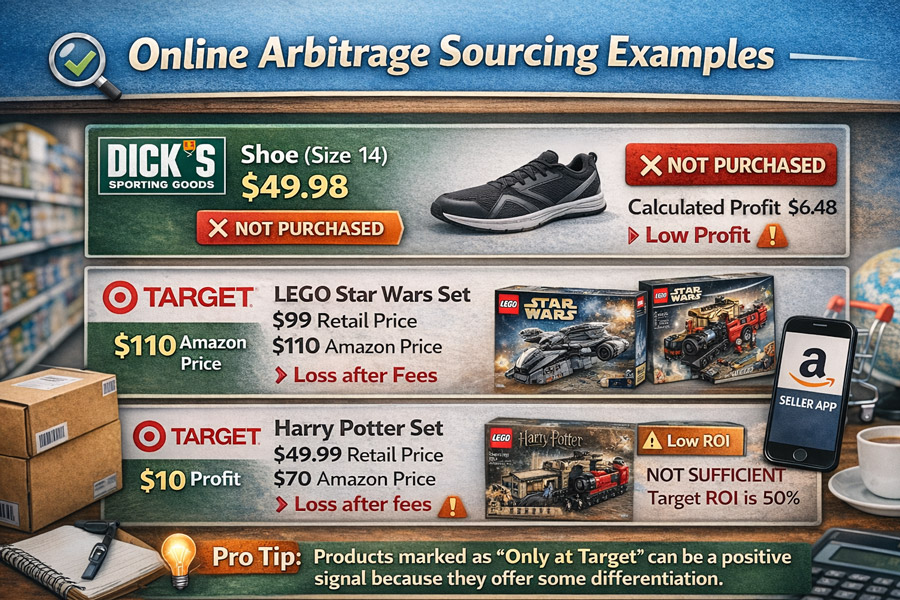
Dick’s Sporting Goods
- Product: Shoe (Size 14)
- Retail price: $49.98
- Calculated profit: $6.48
- Decision: Not purchased due to low profit
Target – LEGO Star Wars Set
- Retail price: $99
- Amazon price: $110
- Result: Loss after fees
- Decision: Do not buy
Target – Harry Potter Set
- Retail price: $49.99
- Amazon price: $70
- Profit: $10
- ROI: 20–25%
- Decision: Not sufficient; target ROI is 50%
Pro Tip: Products marked as “Only at Target” can be a positive signal because they offer some differentiation.
Maximising Profit and ROI
Using Sales and Promotions
When a store offers promotions such as “Buy two, get one free,” the total cost must be evenly divided across all units purchased.
Using Cashback Rewards
Cashback programs such as Rakuten (https://www.rakuten.com) allow sellers to earn additional money while sourcing inventory.
Conclusion: Online Arbitrage Without Paid Software Is Possible
Online arbitrage does not require expensive software to be successful. With patience, consistent analysis, and disciplined sourcing methods, sellers can find profitable opportunities using only the Amazon Seller app and manual research.
While online arbitrage takes time to master, sellers who learn how to source efficiently, analyse data correctly, and think creatively can build a profitable and scalable Amazon business without relying on paid tools.